

UAE Window Tint Law 2026: What Is Actually Legal
The legal tint limit in the UAE is 50 percent on side and rear glass, black film only. The exact rule, the AED 1,500 fine, and what the windshield rule really says.
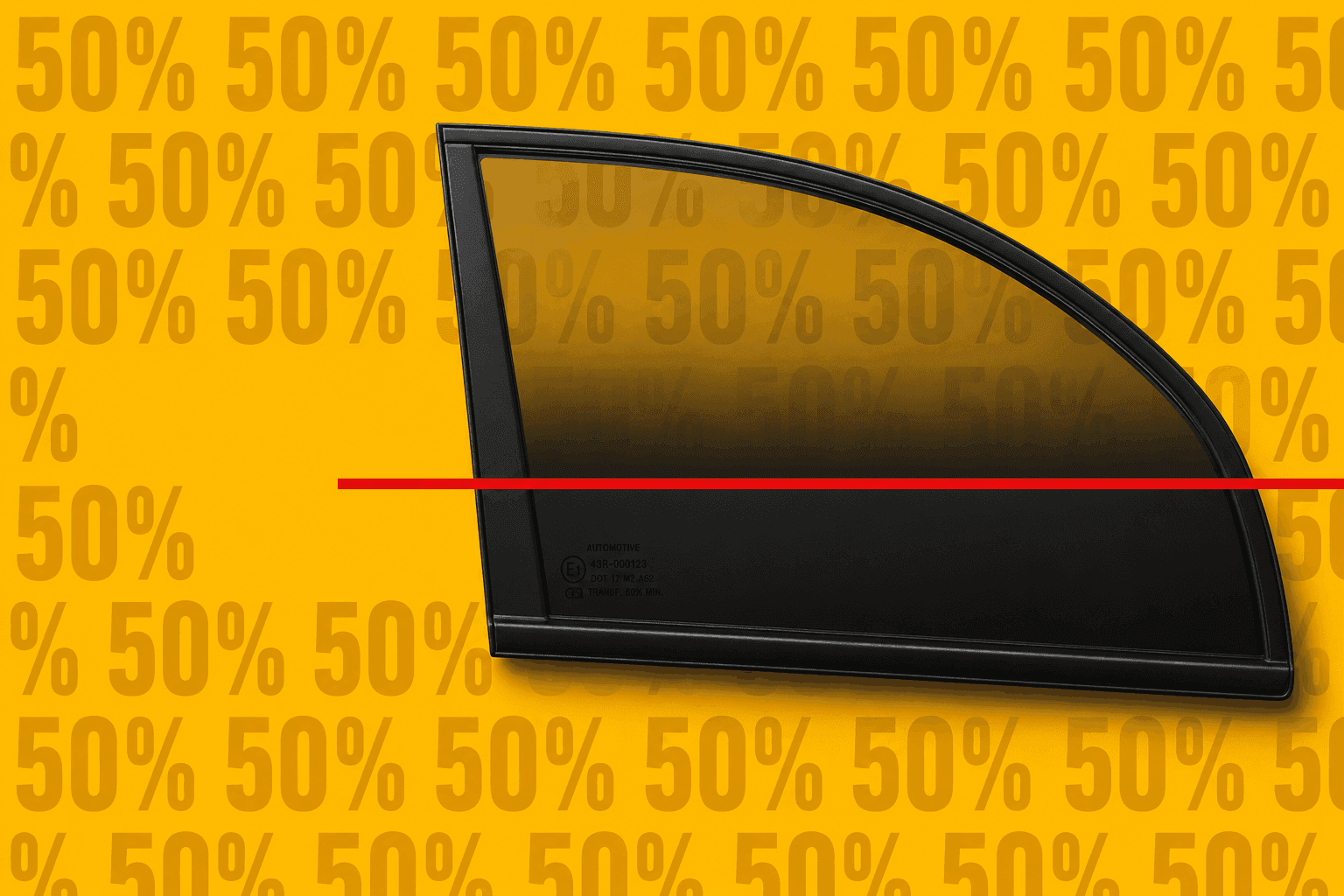
Ask three tinting shops in Dubai what the legal limit is and you can still get three answers. Some pages online quote 30 percent, a figure that stopped being correct on 1 July 2017. Others recommend 35 percent as a safe choice, which is darker than the law allows and will fail an inspection.
Here is the rule, the source it comes from, and the parts that catch people out.
The short version. Side and rear glass may be tinted up to 50 percent. Black film only, no reflective or coloured finishes. The windshield takes a strip along the top edge and nothing else. Exceeding the limit is an AED 1,500 fine. Taxi-plated and heavy vehicles cannot be tinted at all.
The Rule at a Glance
| Glass | What is allowed |
|---|---|
| Front windshield | No film across the main area. A strip along the top edge only |
| Front side windows | Tinting up to 50 percent |
| Rear side windows | Tinting up to 50 percent |
| Rear windshield | Tinting up to 50 percent |
| Film colour | Black only |
| Reflective or mirrored film | Not allowed |
| Taxi-plated and heavy vehicles | Tinting not permitted |
| Fine for exceeding the limit | AED 1,500 |
| Black points | None on the federal schedule |
Which Law Applies in 2026
This is where most articles go wrong, because the UAE replaced its traffic law and a lot of writers assumed the tinting rules went with it.
Federal Decree-Law No. 14 of 2024 on Traffic Regulation came into force on 29 March 2025 and repealed Federal Law No. 21 of 1995. But the UAE Government's official portal, updated in January 2026, confirms that alongside the new decree-law the country continues to apply Ministerial Resolution No. 130 of 1997 and its amendments, Ministerial Resolution No. 178 of 2017, and Cabinet Resolution No. 30 of 2017.
Ministerial Resolution No. 178 of 2017 is the instrument that governs tint. Its Article 9 is the source of the 50 percent figure and it remains operative. Nothing in the 2024 decree-law changed the number.
If a page tells you the tint limit changed in 2025 or 2026, it is guessing. The last change was 1 July 2017, when the limit moved from 30 percent to 50 percent.
What "50 Percent" Actually Means
Article 9 permits tinting a vehicle's glass in black at a level not exceeding 50 percent of the vehicle's interior visibility. Installers usually express the same line in reverse, as a minimum of 50 percent Visible Light Transmission, or VLT. Both phrasings land on the same number, which is why the ambiguity has mostly been harmless.
It stops being harmless the moment you pick a film off a shade chart.
Film is sold by its VLT rating, and a lower number means a darker film.
| Film rating | Light it lets through | Status in the UAE |
|---|---|---|
| 70% VLT | 70 percent | Legal, comfortable margin |
| 50% VLT | 50 percent | Legal, exactly on the line |
| 35% VLT | 35 percent | Illegal |
| 20% VLT | 20 percent | Illegal |
| 5% VLT (limo) | 5 percent | Illegal |
Two details decide whether you pass or fail.
The meter reads the window, not the film. Enforcement uses a handheld light transmission meter placed on the finished glass. It measures film and glass together. Most factory glass is not perfectly clear.
Factory privacy glass is not a free pass. Many SUVs and premium sedans leave the factory with rear glass already below 50 percent. Adding film on top makes the reading worse, not better. Have the existing glass measured before anyone quotes you a shade.
A 50 percent film applied over glass that already reads 75 percent produces a combined result well below the limit. The film's box rating is not the number an officer sees.
Is Your Tint Legal? A Four-Step Check
- Which glass? If it is the front windshield, film is permitted only within a strip along the top edge, up to 15 cm. Anything past that band is a violation.
- Which vehicle? Taxi-plated vehicles and heavy vehicles cannot be tinted at all, regardless of shade. Private, rental and company-owned cars are all eligible.
- What does the meter read? The finished glass must read 50 percent VLT or higher. Below that is a violation, even if the film alone was rated at 50 percent.
- What colour and finish? The film must be black and non-reflective. A film inside the 50 percent limit is still a violation if it is mirrored, chrome-look, or coloured.
Clear all four and you are compliant. Fail any one of them and the penalty is the same.
The Windshield Rule, Correctly Stated
You cannot film the main area of the windshield. That part is not in dispute.
What is regularly misreported is what is allowed at the top. In 2017, Dubai Police clarified the point after drivers in several emirates were fined AED 1,500 for windshield film: a tint strip is permitted along the top of the windshield up to 15 cm, roughly 5.5 inches. Not a factory strip only, and not nothing at all.
Anything beyond that band is a violation. Police in Umm Al Quwain have also warned that placing a heat insulator or any other item across the windshield that obstructs the driver's view while the vehicle is moving is prohibited, which covers the folding sunshade a total of people forget to remove before pulling out of a parking bay.
Colour and Reflectivity
Article 9 specifies black. Abu Dhabi Police have stated the same publicly and added that reflective or blurred glass is banned outright.
That rules out mirrored and chrome-look films, and it rules out coloured films in blue, green, bronze and similar shades regardless of how much light they let through. A film can be perfectly legal on VLT and still be a violation on finish.
Clear films are a separate matter. A transparent heat-rejection or protective film that measurably does not reduce light transmission is not tint in the sense the rule is aimed at. Because the assessment is a meter reading on glass, the only safe approach is to have the reading taken and recorded after installation.
Vehicles That Cannot Be Tinted at All
Article 9 excludes heavy vehicles and vehicles carrying taxi plates. When the 50 percent rule was announced, the Federal Traffic Council confirmed the allowance covered all vehicles other than trucks and taxis, and that rental cars and company-owned cars were included in the allowance.
This is why the federal fine schedule lists two separate tinting offences rather than one. Applying film to a vehicle that is not permitted to have it is its own violation, at the same amount, even if the film itself is within 50 percent.
What It Costs If You Get It Wrong
The federal schedule of violations attached to Ministerial Resolution No. 178 of 2017 sets the penalty under item 68:
| Item | Offence | Fine | Black points | Retention |
|---|---|---|---|---|
| 68 (a) | Exceeding the permitted percentage of vehicle tinting | AED 1,500 | None | None |
| 68 (b) | Tinting a vehicle not permitted to be tinted | AED 1,500 | None | None |
The federal schedule records no black points and no vehicle retention period against either offence. Pages claiming four black points, a AED 500 fine, or a range from AED 500 to AED 2,000 are not describing the federal schedule.
Three consequences sit on top of the fine.
Impoundment in Dubai. Dubai Decree No. 30 of 2023 provides for a vehicle to be impounded where it is found with excessive tinting, or with the windshield tinted without a permit. The release amount is AED 10,000. That is a local Dubai measure, separate from the federal fine.
Abu Dhabi treats it as a permit matter. Abu Dhabi Police have stated the AED 1,500 fine applies both to tinting beyond 50 percent and to tinting without first obtaining a permit. The same advisory sets AED 500 for affixing stickers to a vehicle without permission.
Registration renewal. Tint is checked with a meter during the annual technical inspection. A vehicle that fails on tint does not renew until the film is removed and the car is re-presented, which turns a same-morning errand into two trips plus a removal bill.
Emirate by Emirate
The 50 percent limit is federal and applies in all seven emirates. What differs is the enforcement layer stacked on top.
| Emirate | Limit | Local layer |
|---|---|---|
| Dubai | 50% | Impoundment under Decree No. 30 of 2023, AED 10,000 release |
| Abu Dhabi | 50% | Police advisory frames tinting as requiring a permit; AED 500 for unpermitted stickers |
| Sharjah, Ajman, RAK, Fujairah, UAQ | 50% | Federal rule applies; UAQ Police have issued advisories on windshield obstructions |
Exemptions and Permits
Darker tint can be authorised in limited circumstances, typically on documented medical grounds, and for certain official vehicles. The route runs through the police or licensing authority in your emirate, and approval is meant to be obtained before the film goes on rather than produced afterwards. Keep the permit in the car. Without it in hand, an officer has a meter reading and nothing else to go on.
If you think you qualify, confirm the current process directly with your emirate's traffic authority before booking any work.
Five Questions Before Anyone Touches Your Glass
- What is the current VLT reading on each window, measured before you start?
- What is the rated VLT of the film you are proposing, and what will the combined reading be afterwards?
- Will you measure and record the final reading on every window?
- Is the film black and non-reflective?
- Will I get written documentation of the finished readings to keep in the car?
A shop that cannot answer the first question does not own a meter, and a shop without a meter is guessing on your behalf.
The registered owner carries the violation, not the installer. "The workshop said it was legal" is not a defence at a roadside check.
At AutoGlow, every tint installation at our Dubai and Abu Dhabi studios is measured on the glass before and after, and the finished readings are documented for you. See the full process on our window tinting service page.
Myths, Corrected
| Commonly published | What the sources say |
|---|---|
| The limit is 30 percent | Correct until 1 July 2017. It has been 50 percent since |
| The 2024 traffic law changed the tint rules | MR 178 of 2017 still applies alongside the new decree-law |
| 35 percent is a safe, popular choice | 35 percent VLT is below the limit and is illegal |
| Front and rear windows have different limits | Article 9 sets one figure for side and rear glass |
| The windshield allows no film at all | A strip up to 15 cm along the top is permitted |
| The fine carries four black points | The federal schedule records none |
| Brown, grey, blue and green films are permitted | Article 9 specifies black |
| Rear privacy glass exempts you | The meter reads glass and film combined |
Frequently Asked Questions
Is 35 percent tint legal in the UAE? No. A 35 percent film transmits 35 percent of visible light, which is below the 50 percent limit. It is illegal on all windows of a private car.
Is 70 percent tint legal in the UAE? Yes. A 70 percent film transmits more light than the 50 percent minimum, so it sits comfortably inside the limit.
Can I tint my front windshield in the UAE? Not across the main area. Dubai Police have confirmed a tint strip is permitted along the top of the windshield up to 15 cm, roughly 5.5 inches.
What is the fine for illegal window tint in the UAE? AED 1,500, under item 68 of the federal violations schedule. It applies both to exceeding the permitted percentage and to tinting a vehicle that is not permitted to be tinted.
Does an illegal tint fine carry black points? The federal schedule lists no black points and no retention period for the tinting offences. Separate local measures can still apply, including impoundment in Dubai under Decree No. 30 of 2023.
Are rental cars and company cars allowed to be tinted? Yes. When the 50 percent allowance was introduced, the Federal Traffic Council confirmed it covers rental and company-owned vehicles. Rental agreements may still prohibit modifications, so check the contract.
Did the new 2024 traffic law change the tint limit? No. Federal Decree-Law No. 14 of 2024 took effect on 29 March 2025, and the UAE Government portal confirms Ministerial Resolution No. 178 of 2017 continues to apply. The limit remains 50 percent.
Are mirrored or coloured films allowed? No. The rule specifies black, and Abu Dhabi Police have confirmed reflective and blurred glass is banned.
Sources
- Road safety, The Official Platform of the UAE Government. Updated 6 January 2026. Confirms Federal Decree-Law No. 14 of 2024 in force from 29 March 2025, and that MR 130/1997, MR 178/2017 and Cabinet Resolution 30/2017 continue to apply.
- List of traffic offences and violations (PDF). Ministry of Interior and Abu Dhabi Police GHQ, schedule to Ministerial Resolution No. 178 of 2017. Item 68 (a) and (b).
- Ministerial Resolution No. 178 of 2017, Article 9, as reported citing the Ministry of Interior: Ajman News.
- Car window tinting rule changed in UAE, Gulf News. The 30 to 50 percent change effective 1 July 2017.
- Tint up to 15cm from top allowed on windshield, Gulf News. Dubai Police clarification.
- Abu Dhabi: Dh1,500 fine for car tinting without permission, Gulf News.
- UAE: Car's windows too dark? You may have to pay Dh10,000 to release the car, Gulf News. Dubai Decree No. 30 of 2023.
- Ministerial Resolution No. 130 of 1997, Executive Regulation of Federal Law No. 21 of 1995. Articles 177 and 183.
Last reviewed 14 August 2026. Traffic regulations can be amended. For a binding answer on your specific vehicle, confirm with the traffic authority in your emirate.
Ready to Protect Your Vehicle?
Experience industry-leading XPEL paint protection film and ceramic coatings at AutoGlow Dubai & Abu Dhabi studios.